Monday, 3 February 2014

Apply this Winning Email Strategy from December 31st all Year Long

Donors are kind to nonprofits in December, so it's only fair we return the favor to them – all year long.

My recent post may be perceived as heavy handed when it comes to email volume, and though that is true for the large part (no denying!), my point has always been to not send email for the sake of sending email. Have a plan, devise a strategy, know your audience, and respond appropriately when communicating electronically.

What is email appropriateness? Do not spam. Say goodbye to spray-and-pray. And question unbridled urges to blast the entire housefile. Every organization needs a gatekeeper; your donors will thank you.

But it is possible to send more email and see greater results while being thoughtful to your donors in 2014.

This is done through more advanced segmentation. For example, if my housefile is 10k and I send one email to everyone that's 10k sends, but if I slice my file into two groups and send a total of three messages, I will have sent 15k total emails. Sending smaller, more personalized communications that align to needs of audience often results in a higher number of base sends.

new england aquarium logo 365x150 Apply this Winning Email Strategy from December 31st all Year LongMy favorite example of this approach has been adopted by the New England Aquarium at year-end. Two emails go out on December 31st, one in the morning and one in the evening. Using Luminate Online's Email Response Rate Segmentation Task, the second email targeted those who had opened or clicked an email over the previous 90 days (i.e. duration of year-end campaign) but have not given to the Aquarium.

The results have had a significant impact on email driven revenue in December. In 2012, the afternoon email sent by the Aquarium resulted in a 49% bump of funds raised by email on the last two days of the year. In 2013, the second email accounted for 17.5% of added email driven revenue on the last two days of the year. This is a drop from the previous year, but then again the aquarium saw a 525% increase in total email revenue driven in December.

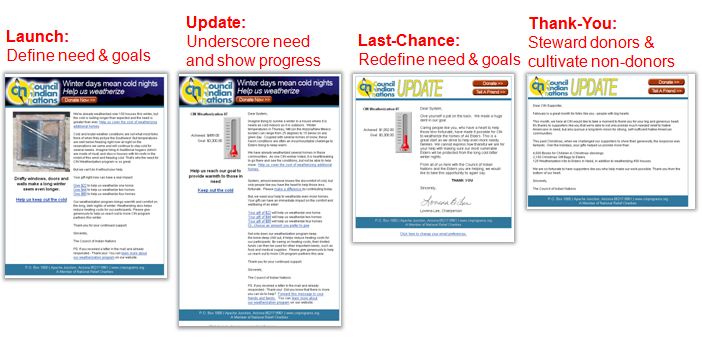
How can this winning email strategy be applied all year long? Though similar in principle to email remarketing, there are many use-cases for this particular email strategy but I will focus on just one. If we look at the anatomy of a typical fundraising campaign, there are four basic parts: Launch, Update, Last-Chance, and Thank-You. See below.

BehaveSeg Apply this Winning Email Strategy from December 31st all Year Long

To apply this winning email strategy to your organization's everyday fundraising campaign, all that needs to be done is to introduce a fifth message. Yes, more email, but also a more thoughtful approach that will seek to drive higher number of actions for fundraising or advocacy campaigns.  After the Last-Chance email, a follow up email can be sent to those who've opened or clicked on previous messages by have not acted on the campaign.

This can be completed in Luminate online by using the Email Response and Segmentation Task, specifically Engagement Factors. Once the Engagement Factors have been created, the query can be built using the Task criteria. After the query has been completed, run the query and build the group for the more personalized, follow up message to the targeted audience.

Does your organization have other ways to deepen engagement with your constituents through more frequent, but targeted emails? If so, please share or let me know. Thanks!

View full article


(unsubscribe from this feed)

Nonprofit Web Design Process Part 4a: Sitemaps

Note: This is the eighth in a series of posts about the Nonprofit Web Design Process. See the end of this post for a linked index of other posts in the series.

Purposes

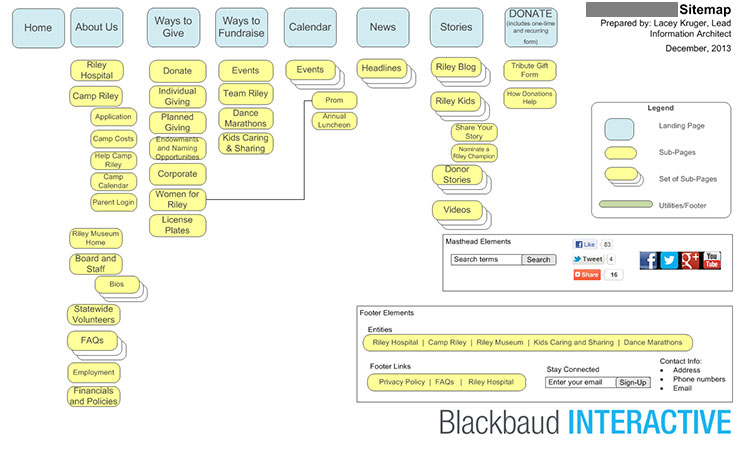
Your sitemap is a visual representation of the structure of your website. It defines all of your sections of content and which pages belong in each section. Ultimately, the sitemap will be what's represented by your website's navigation.

Purposes for the Sitemap include:

  • Defining each tier of navigation for your website
  • Identifying links and utilities that need to be present on ever y page of your website including Search, Social Sharing, Login, etc.
  • Showing a comprehensive view of your website to ensure all content has a logical home

Methodology

To create a sitemap, we begin with the documents produced during the Content Strategy phase. By reviewing the content inventory and content audit, we can get a pretty comprehensive view of all pages that need to be included in the new website.

Armed with a list of pages, we then group the pages into meaningful sections and tiers. Card Sort tests are a very helpful input to help determine which groups make the most sense for end-users of the website. We can also rely on our own expertise and online experiences to determine appropriate groups. Conventions such as a "Donate Now" button and an "About" section give us a starting point that most users will be accustomed to seeing.

It is most important to keep users at the forefront when developing a sitemap. While it may make it easier for an organization to structure the website according to their org structure, this can be frustrating for users. Thinking about what users are looking for when they come to the website and organizing according to their needs will make for a successful sitemap.

Ideally, we'll have some insight into user needs thanks to the research we conducted in earlier phases of the project such as Surveys and Interviews or Personas.

For all nonprofit sites, it’s important for your sitemap to facilitate learning about your organization and your impact since most users will want to learn a bit before donating or engaging in other ways.

Sitemap example Nonprofit Web Design Process Part 4a: Sitemaps

Deliverables

A sitemap deliverable usually begins as a "boxes and arrows" diagram like you see above. You can use tools like Microsoft Visio, Cacoo (a free, online tool), or even Microsoft PowerPoint to create sitemaps.

In later phases of the project, I tend to transition from the graphic sitemap back to the old spreadsheet we used during the Content Strategy phase. The spreadsheet allows us to get page-by-page granular with the sitemap and create a checklist for content authoring, editing and publishing before launch.

What's Next

Since the Sitemap defines our website's navigation, it is a primary input for Wireframes, which we'll discuss in the next post. By looking at how many tiers of content you have represented in your Sitemap, you can determine which pages you should wireframe. (Hint: one wireframe for each tier of content is a good starting point.) Stay tuned!

Other Posts in this Series

  1. Introduction
  2. Stakeholder Discovery
  3. User Research
  4. Content Strategy
  5. Information Architecture
    • Sitemaps [this post]
    • Wireframes
  6. Visual Design
  7. Solution Design

View full article


(unsubscribe from this feed)

Facebook AND Email – The Marketer’s Chocolate Peanut-Butter Cup

At no point in Facebook's history has it been easier or more valuable for organizations to bring their email and Facebook strategies together. And, the impact of tightly connected Facebook + email strategies will only grow as Facebook continues its march to become a dominant part of every marketer's toolset.

If you grew up in the 1980's, you'll remember the TV commercials for Reese's Peanut Butter Cups.

In one ad, a boy and a girl are walking down the sidewalk in opposite directions. The boy is savoring a chocolate bar while the girl blithely snacks on a jar of peanut butter. The commercial culminates when the two collide and their previously separate snacks come together. Voila, they find that the treats are even better together!

Well, replace the chocolate bar with email and the peanut butter with Facebook, and you have a modern day match made in heaven.

I realize this is a bit of a weird analogy, but it's one that comes to mind for me quite often when I talk with people who spend their days working to engage people via email or Facebook, but not with both working together.

For years organizations have treated Facebook and email as entirely channels for reaching and engaging supporters. But increasingly, the organizations that successfully merge their email and Facebook efforts find themselves with far more benefits than they enjoyed before –just as our hero and heroine in the Reese's Peanut Butter Cup commercial do.

Facebook's recent changes provide organizations with opportunities to reach new people, capture their data and cultivate meaningful relationships –all right inside Facebook. At the same time, email remains the best channel for much of the marketing that organization do today. Combining your Facebook and email efforts creates a synchronistic relationship where one plus one equals a huge increase in benefits for your organization.

Three Ways Facebook Supports Email Marketing

Facebook is moving quickly to make it easier for companies to leverage the information and networks of its 1.2 billion users in ways that add real value to all marketers: both nonprofits and for profits. Over the past 18 months, Facebook has made important changes to its:

  1. API's
  2. Open graph
  3. Search technology
  4. Terms of service
  5. Advertising tools

If you look closely at the changes they have been making, you quickly see the direction the company is going. Simply put, we can now capture data and interact on Facebook today in ways we wouldn't have dreamt of doing just 12 months ago. Moreover, we'll be able to do things in 12 more months that are not even on our radar today. And importantly, many of these things will have the power to augment email efforts in ways that organizations have not yet realized.

If you have heard me talk about the value of Facebook over the past year, you probably know I break it into three main buckets:

  1. Reaching your target audience
  2. Cultivating more productive relationships
  3. Capturing data so you can evolve those relationships on and off Facebook.

1. Reach Here's a simple example of how to combine email and Facebook to reach your current supporters and gain new ones. Last month, Sierra.Rise ran an email campaign that drove their supporters to a post on their Facebook page instead of to a petition page on their website. The post itself included a clear call to action that went beyond clicking Like, Share or Comment –it asked people to sign a petition. That petition resided directly inside Facebook. As a result of this effort, the organization accomplished the following:

  1. The post itself outperformed any other post they had published on their Facebook page in months.
  2. They grew their page with high quality supporters.
  3. They captured the names and FB User ID's for every person that clicked Like or Commented on the post itself so they can track their engagement over time.
  4. They captured the email address of every person that "signed" the petition.
  5. They reengaged existing supporters and captured data to help them better understand their interests.

Based on data from other ActionSprout customers, had Sierra.Rise simply pushed people to take action on their website, they would have foregone the reach, grown their Facebook fan page by zero, and captured only a fraction of the new supporters they did with this effort.

How To Do This: Drive people to take action on your Facebook page instead of a petition form on your website. Sierra.Rise drove people to a post where they could like, comment and share before clicking through to complete the action on their ActionSprout tab.

2. Cultivation For far too long organizations have been content with seeing their Facebook page as a place to "build awareness" of their causes. But as a public company, Facebook knows that its paying customers require real, measurable, returns on their advertising investments. As a result, they are making it easier for organizations not only to reach their target audiences on Facebook, but to engage them in ways that go beyond Like, Share and Comment through using the new custom actions feature. Most people first experienced Facebook's new custom actions when they started seeing stories in the news feeds about friends listening to a song on Spotify.

By giving app developers like ActionSprout the ability to add new actions for people on Facebook to take directly in the newsfeed, Facebook also opened up the ability for organizations to build deeper relationships with people right inside Facebook. ActionSprout is the first (and, as yet, only) company to leverage Facebook's latest API's, custom actions, and the open graph to support the unique engagement needs of nonprofit organizations.

Facebook AND Email   The Marketers Chocolate Peanut Butter Cup

A recent Unicef action asking people to stand with children of Syria.

3. Capture Without a doubt, the #1 reason organizations use ActionSprout is because we provide powerful ways to capture data, including email addresses, from people that take meaningful action for their cause or candidate on Facebook. Most organizations have been investing in building Facebook communities for years. These organizations have a tremendous amount of pent-up value locked away inside Facebook in the form of fans and communities. And that value just keeps growing. A study done by NTEN and M+R in 2012 showed Facebook fan growth of 46% –far outpacing email list growth.

Yet until very recently, the only way to capture email addresses of people on Facebook was to drive them OFF Facebook to a website or app where they could fill out a form and hit submit.

This form of supporter capture is as old as email and website use in the nonprofit sector itself. But, as any organization that has tried this knows, driving people to take action from Facebook by filling out a form (on or off Facebook) has always fallen flat. There are two primary reasons for this:

  1. The completion rates on these forms are very low whether they reside on the organization's website or are hosted on an app on their Facebook page.
  2. More importantly, these forms are almost always a viral dead end, which defeats the entire point of Facebook. This means, if you are lucky enough to have a post on your Facebook page that does drive people to take action from it, it will simply fail to be shared and spread. In other words, the more successful organizations are at creating posts that drive people to take the action, the less viral it is!

But with Facebook's newest API's, the open graph, and rules for app developers, it's easier than ever to give people meaningful actions to take directly from their newsfeed without leaving Facebook. We can then capture their data without forgoing the viral impact of people engaging and sharing content directly on Facebook. This, in a nutshell, is why ActionSprout exists.

Facebook today offers organizations a very cost effective email list growth strategy. In the past, very few organizations really looked to Facebook for list growth. This isn't because organizations haven't wanted to grow lists using Facebook –it's because there were no good ways to do it!

But times have changed. Organizations that use ActionSprout, for instance, can now log into their ActionSprout account, or connected CRM, and quickly find their most active Facebook supporters. Moreover, on average, each post that includes an ActionSprout powered call to action converts 5% to 20% of the total number of people that engage with the post by clicking Like, Share or Commenting on it. In other words, if an organization's post has 100 people Like, Share or Comment on it, they will receive between 5 and 20 new email addresses from people that were ready to engage beyond Like, Share or Comment.

Facebook AND Email   The Marketers Chocolate Peanut Butter Cup

This action has 10,188 people click like or comment on wall posts that include a call to action, and 1,224 people completed the action.


How Email Adds Value to Facebook Efforts

If you've been paying attention to Facebook at all over the past year, you probably know that when an organization posts something to their wall, Facebook only delivers it to 15% of their Fans. That's like having an email list with an 85% bounce rate. Sure, you can pay to get that message seen by more of your fans, but the fact that individuals are bombarded with an average of about 1500 pieces of content each time they log into Facebook, means viewer blindness kicks in. Email is and will be the most direct and controllable means of reaching supporters electronically for quite some time.

The amount of money currently being raised on social sites like Facebook is minuscule compared with the ever growing amount of money being raised via email. Direct mail still dominates fundraising but email is growing in importance. Raising money on Facebook holds a lot of potential, but today, it's just that –potential, not reality.

The good news is that by using Facebook hand in hand with email, organizations can have the best of both worlds. It's getting easier for organizations to leverage Facebook to support and augment email efforts in a number of important ways.

Benefits of Multi-Channel Reach and Engagement

I mentioned in the email overview above that although email open rates have remained steady at 15%, click through rates have dropped to .7%. The good news is that Facebook is working furiously to give marketers new ways to target existing email supporters on Facebook at the same time that those marketers are working to reach them via their email inbox.

A study done around #GivingTuesday last year showed that organizations that used social channels along with email produced 10X the donations on that day. Other studies put the value of a Facebook fan at $161.30 over a 12 month period. Those 5 to 20 new email addresses you gain for each 100 people clicking Like, Share or Comment adds up to an impressive increase in revenue very quickly, but I have a hard time imagining how numbers like these can be generated without an organization reaching these fans directly via email.

At ActionSprout, we have just begun to explore leveraging Facebook's ever-changing advertising potential. But one thing is clear: one of the most powerful ways to target users on Facebook in the near future will be to target those individuals that already have relationships with an organization.

Facebook AND Email   The Marketers Chocolate Peanut Butter Cup

You can target people you already have relationships with on Facebook

These are early days for Facebook and for ActionSprout. Each month (and often each week) Facebook releases some new feature or permission that opens up new possibilities. It can be a bit daunting to think about what the future holds for organizations that depend on electronic communications to engage supporters. But as someone who has been helping nonprofits navigate the world of electronic communications for over a decade, I can honestly say, the future is bright.

View full article


(unsubscribe from this feed)

Spring Online 2014

Spring Online is an award winning initiative from Digital Unite which makes it possible for thousands of people, often older people, to try out computers, tablets and the internet, many for the first time.

This year, between 31 March - 4 April 2014, thousands of free taster events and sessions will be held by volunteers and organisations across the UK to help and inspire local people achieve a lasting use of the internet.

So if you can show someone how to use a computer keyboard, browse a tablet device, send an email, search the web or shop online, get involved today!

Click here to find out more.

View full article


(unsubscribe from this feed)

Bidtech offers 24 charities free event service

Specialist fundraising technology company Bidtech has launched a new project, ‘Bidtech Challenge,’ which will give 24 charities the chance to receive £4,000 worth of fundraising technology for their charity event.

Bidtech provides interactive iPad-based technology for charity events, which allows guests to bid for auction items via an application loaded on to iPads.

Recent research shows that the use of technology at fundraising events delivers an average of 10 times the return of investment for the charity. Bidtech wants to give fundraisers that don’t have the budget for interactive event technology a chance to use the most innovative fundraising tools on the market and raise even more money for their charity.

Winning charities will receive a full event service of up to 250 iPads, fundraising software, smart phone bidding capability, payment processing, a registration tool, and a full event support team.

Bidtech CEO, Paul Beck, said: “We have worked with a multitude of inspiring charities over the years and want to give something back to the sector. We look forward to helping these charities increase their fundraising effectiveness.”

Click here to enter the Bidtech Challenge.

View full article


(unsubscribe from this feed)

iBid kicks off 2014 with Institute of Fundraising award

iBid has won the Best Digital-Tech Partner Charity Facing, awarded by the Institute of Fundraising, for the second year running.

iBid is the recognised leading professional in interactive fundraising solutions. The company continues to invest in new technology and equipment, new personnel and premises.

Tim Stansbury, Managing Director of iBid, said: “It was an important year for building on our proven event expertise, introducing new technology platforms and strengthening our existing client relationships. Our client list reflects the professional approach we apply.”

“We expanded further into overseas markets with successes in New York with New York Stage & Film, San Francisco with the Andrew Simpson Sailing Foundation and in Canada with STARS Foundation. We continue to work with annual clients such as Great Ormond Street Hospital and The Prince’s Trust, sports interests, such as the Bobby Moore Fund and the Arsenal Foundation, schools such as Wellington College and Knightsbridge School. It’s a very rewarding and exciting time. We are looking forward to continued growth in the coming year.”

View full article


(unsubscribe from this feed)

Sunday, 2 February 2014

The Nonprofit Weekly Roundup: An Aretha Tribute, Upworthy Headlines, and Blogs You Should Be Reading

I completed my annual review last week.

And I’ll be honest, I put that thing off as long as possible.

For someone who seems to have no problem talking about themselves, you’d think I would welcome the annual review like a child welcomes Birthday presents or money from the Tooth Fairy.

Surprisingly, that’s hardly the case. I put measuring my accomplishments and failures on the same level as trying to run a mile for the first time in 3 years. Zero fun.

But, like running again for the first time (however painful it might be), there’s reward in looking back on your year in review. You recognize what you’re capable of – reminded of how strong you actually are – and also what work is still to be done. In my case, there’s loads. and loads. And you know what the means? More opportunity to marvel over accomplishments this time next year.

Maybe you killed it this year, exceeded expectations and went above and beyond. Maybe you tried new things and they totally flopped. Either way, it’s February already and there’s work to be done, so I’ll share with you some helpful words from the wise..

Here are this week’s nonprofit highlights:

  •  Want to know The real secret to great fundraising writing? I’ll give you this much: it’s built on a willingness to get outside of yourself. Jeff Brooks shares more on the topic, and how you can write like Neetzan Zimmerman, in his Future Fundraising Now post.
  • Aretha Franklin spelled it first (well, you know what I mean) and Nancy Schwartz is spelling it again. In her npEngage post, How to R-E-S-P-E-C-T Your Way to Donor Retention, Nancy guides you through the steps of creating lasting donor relationships. The result? Better donor retention.
  • On the #fundchat blog, Brandan Kinney shares BlueHost’s infographic on Social Media for Social Good. It’s no surprise that social media has taken off, but you may be surprised to see the recent trends towards charity. With nonprofit campaigns going viral and celebrities like Justin Timberlake and Lady Gaga using their voices for good, it’s encouraging to see that we’re progressively using the platforms with a bigger purpose.
  • Ignoring Your Current Donors? 75% of Them Will Be Gone Within the First Year. Really. But in the spirit of doing things differently this year, Frank Barry writes for Hubspot and shares a few ways you can leverage the internet and technology to keep more of your donors around.
  • Upworthy Type Headlines: To Like or Dislike? Well, there’s really no denying it. Upworthy has totally nailed the ‘stop whatever it is you’re doing and read this and then go share it with everyone you know’ headline. But is their style a fit for your nonprofit? Allyson Kapin says to start with testing and keep things relevant before amping your content creativity to the ‘Upworthy’ degree.
  • Want to be a bit better in 2014? Start by reading and learning from others. Brady Joseph guest stars on Hubspot’s blog with 7 Must-Read Blogs to Inspire Your Fundraising Efforts. Check it out – be inspired. (Psssst..Brady…thanks for the npEngage shout out)

Did I miss anything?

Do let me know.

Yours truly,

Madeline

View full article


(unsubscribe from this feed)